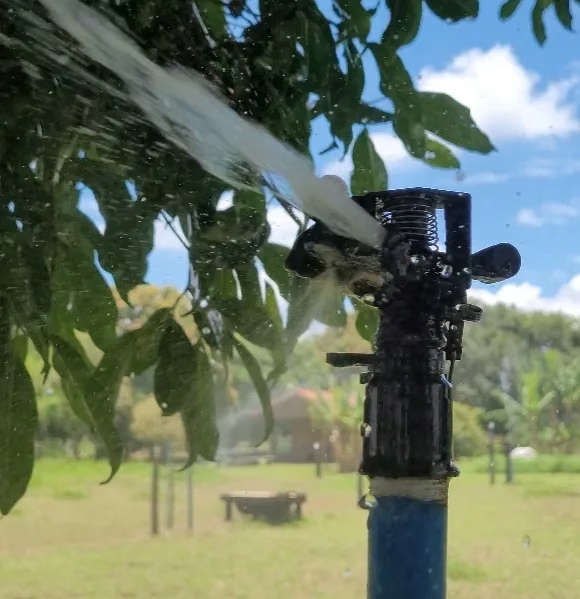
Summary: If rainfall has reduced irrigation in your area, use the opportunity to inspect the system. This checklist covers filters, lines, emitters, the pump and automation. Maintenance must follow the design and equipment manuals, with appropriate procedures for inspection, intervention and operational testing. The rainy season does not remove the need to monitor water availability in the soil.
Why the stopped system also needs maintenance
A break in irrigation does not prove that the equipment is ready to return. Deposits, leaks and instrument failures can go unnoticed until the next start-up. It is worth comparing the current condition with the operation records, without expecting unevenness to appear in the crop.
O UF/IFAS maintenance guide recommends tracking components and performance. The script below organizes this review for a pause or reduction in the operation. It does not establish that every system must stop during the rains: the decision depends on the crop, the soil and the rain actually used.
Irrigation system maintenance checklist during the rainy season
The list guides service planning. Frequency, sequence of maneuvers and procedures depend on the installation and each manufacturer. Before opening filters, connections or other components, the responsible team must isolate the section, relieve pressure and prevent unexpected starts. Electrical and mechanical interventions require the equipment's own safety measures.
1. Filters: clean, inspect and record
- Schedule cleaning of screens and discs and backwashing of granular media filters according to the manual. Assess the condition of the filtering medium when applicable.
- Inspect elements and seals with the set released for maintenance. Record damage, incorrect assembly or accumulated material.
- Compare pressure and flow under similar conditions. The pressure differential helps monitor the filter, but it changes with the flow rate, the position of the valves and the condition of the pressure gauges. An isolated reading does not prove dirt, breakage or correct assembly.
- Note the condition before and after service. Date, sector, readings and parts replaced make the next inspection more useful.
The content about irrigation filters explains the role of each type in the system.
2. Lateral and submain lines: flushing
- Plan network washing, including main lines, derivations and laterals. Follow the sequence planned for installation, without transferring sediment between sections that have already been cleaned.
- Check the washing conditions. Opening all lines at the same time can reduce the flow available in each one. Number of open lines, pressure and water disposal must be defined according to the project and the manufacturer.
- Evaluate material removed and subsequent performance. Visually clean water at the end of the line does not prove that the internal passages of the emitters are unobstructed.
Upon resumption, check whether there is a need for new washing and testing of the sector; do not adopt a single range for any water quality.
3. Emitters: evaluate before the problem appears in the plant
- Observe the sector in a safe functional test, looking for leaks, emitters without discharge and changes in the pattern of micro sprinklers.
- Compare flow and pressure with the project reference conditions. The article about drip uniformity test presents the distribution assessment.
- Investigate the cause. Inadequate pressure, leaks, and blockages can produce similar symptoms. Deposits can also combine particles, biofilms and precipitates. See the causes of clogging of drippers.
Do not improvise when unclogging the emitter: follow the cleaning or replacement procedure indicated for the model.
4. Water quality: rain changes the source
After intense rains, the water collected may change. They vary with the source, catchment protection and basin conditions; no increase in turbidity or contamination is assumed on the entire property.
- Observe changes in source and capture, in a safe place, such as floating material, sediments or changes in appearance.
- Rate new analysis when there is a relevant change or history of problems. Appearance does not replace the report. The guide to water analysis for irrigation guides the conversation with the laboratory.
- Inspect sieves, screens and capture devices according to the manual, without entering water or accessing energized equipment to perform the check.
5. Pump set and engine room
- Assess coverage, drainage and signs of water ingress. Panel protection and engine ventilation must comply with the design; Do not improvise seals that harm the equipment.
- Send the electrical part to a qualified and authorized professional. Maintenance must occur with de-energization and prevention of accidental re-energization, in accordance with the applicable safety procedure. Turning off the controller does not equate to releasing the equipment for work.
- Consult the manual before scheduling maintenance or test runs. There is no universal trigger schedule. The team must confirm the necessary hydraulic and electrical conditions; Do not operate dry or connect equipment suspected of damage, flooding or protection failure.
- Check the instruments. Pressure gauges and flow meters need to provide reliable readings for design comparison.
O Schneider/Franklin Electric motor pump manual exemplifies these safety precautions. Specific start-up and maintenance conditions must come from the installed equipment manual. Do not perform electrical work during thunderstorms.
6. Piping, valves and connections
- Look for damage, leaks and exposed pipes by machine traffic, animals or erosion, without accessing unstable areas.
- Check valves and control devices according to the project. Do not indiscriminately open or close all registers during operation; Incorrect maneuvering may compromise operation.
- Record what needs repair and release the section for intervention. Disassembly and testing must respect the pressure limits and manufacturer's procedures.
7. Automation, injectors and fertigation
- Review the schedule with field data. Soil moisture and rain harvested help decide whether irrigation should be reduced, suspended or resumed.
- Check the injection system. Cleaning, washing and maintenance must be compatible with the products used and the installation. The article about fertigation brings together points of attention.
- Check sensors and registers. Tensiometers and electronic sensors require different installation and maintenance precautions. Consult the manufacturer and comparison tensiometer or soil moisture sensor.
Chemical treatment: only with diagnosis and guidance
A break in the system is not a reason, in itself, to apply chlorine or acid. Treatment depends on the water, the deposit and the compatibility of the materials. It must be defined and executed by qualified personnel, with technical guidance, label, Safety Data Sheet (SDS) and instructions from the manufacturers.
Never mix acid with hypochlorite or other chlorinated products. Separating tanks or injectors alone does not prove the safety of a combined program. The comparison dripper cleaning: chlorine or acid explains functions and limits without providing a universal recipe.
How to organize your routine
Organize the registration into three moments:
- Before a planned stop: list pending issues, carry out recommended maintenance and define the conservation of equipment according to the manuals.
- During usage reduction: monitor the need for irrigation, observe the installation after relevant events and only carry out the checks foreseen in the plan.
- Before resuming: confirm that repairs have been completed, release the equipment for operation and compare pressure, flow and uniformity in a safe test.
Define who performs each task and what results need to be recorded. This allows you to distinguish a completed inspection from an issue still pending.
FAQ
Do I need to completely turn off the irrigation system during the rainy season?
There is no answer based on the calendar. The decision depends on the crop, soil and rainfall distribution. Monitor the humidity and management of the area. Release for maintenance is another decision: it must prevent unexpected activations while the team intervenes on the equipment.
How often should I flush drip lines?
The range depends on water, filtration, observed deposits, and operating history. Record washing conditions and monitor emitter performance. Water color and uniformity help with assessment, but do not alone identify the cause of a problem.
Can rainwater clog the system?
Rain can alter the water collected and transport material to the source. You may also want to look for damaged or exposed spots after a flash flood. Do not conclude that all obstruction came from rain: the investigation must consider capture, filtration, hydraulic conditions and composition of the deposit.
Who should perform electrical maintenance on the pump?
Qualified and authorized professional for the service, with installation safety measures and manufacturers' instructions. Do not open panels or perform electrical tests yourself. Suspected flooding, damaged cable or protection failure requires evaluation before any new start-up.
Conclusion
If operation has slowed down due to rain, use this break to review what needs attention. A checklist with those responsible, readings and pending issues helps prepare for resumption without relying solely on a visual inspection or a quick start of the pump.
To talk to Perin about reviewing the system, gather the municipality, crop, approximate area, water source and available pressure and flow records. Contact is via WhatsApp (14) 99824-5219 or by email contato@perinirrigacao.com.br.
Sources consulted
Source search on 10/26/2026; technical conference on 10/28/2026. The sources support the general criteria. Maintenance of each component must follow the manual for the installed model.
- University of Florida, IFAS/FAWN. Maintenance Guide for Microirrigation Systems in the Southern Region, sections 3 and 4: component maintenance and water treatment.
- FEITOSA FILHO, J. C.; SILVINO, G. da S.; PINTO, J.M. Preventive and operational measures to avoid obstructions of pipes and emitters of irrigation and fertigation systems by drip or microsprinkler in water containing agents of a physical, chemical and biological nature. Athena, 2024, chap. 8, pp.77–95. Text in the Embrapa repository.
- Schneider/Franklin Electric. 4” multistage submersible motor pump — Instruction manual, C1 series. Safety, installation preparation and maintenance, pp.4–7, 12 and 18. Manufacturer's manual.