
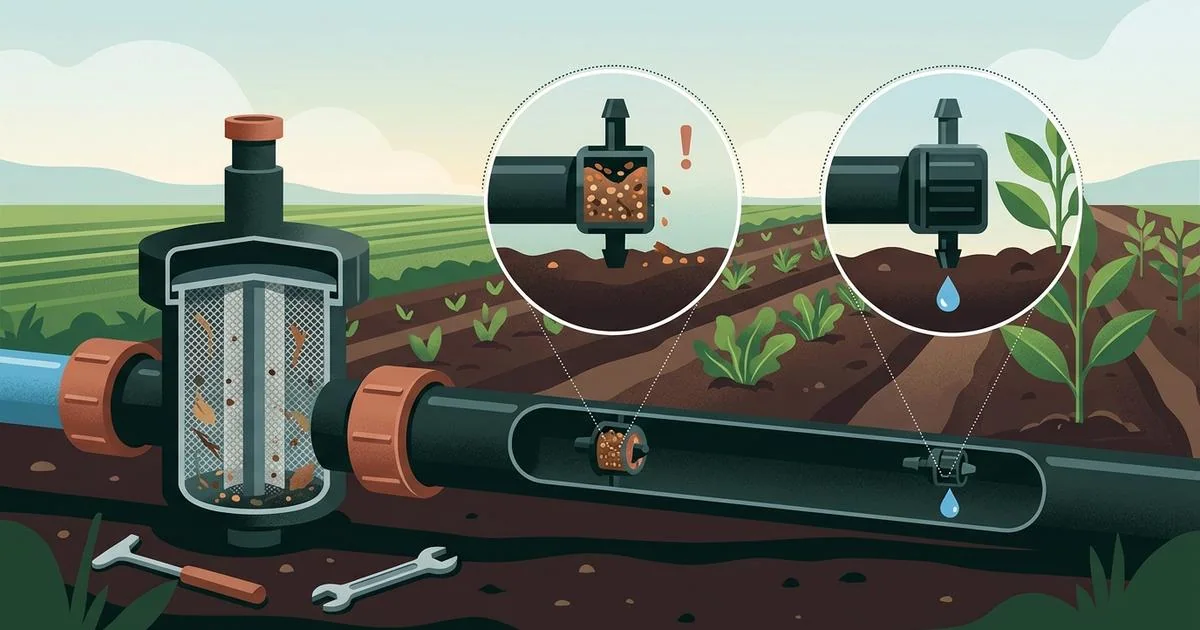
Summary: Clogging of drippers rarely has just one cause. Particles, chemical precipitates (iron, calcium, manganese) and biological slime usually act together, and the filter only solves part of the problem. This article brings together the design, operation and maintenance errors that most favor obstruction, based on technical literature from Embrapa, universities and manufacturers, and shows what to measure to act before the lack of uniformity appears in the field.
The issuers of drip They have small passages, and this is what makes it possible to apply little water with precision. It is also what makes them more demanding regarding water quality, as researchers highlight in a technical article in Revista Cultivar (Szekut et al., 2021). A technical chapter with the participation of Embrapa Semiárido states that obstructions in pipes and emitters "are frequent" in localized systems and points out suspended solids, excess iron and manganese and organic matter as the main causes.
The causes are usually grouped into three types:
- Physics: sand, silt, clay, plastic fragments and organic remains carried away by the water.
- Chemicals: precipitates such as calcium carbonate, magnesium carbonate and iron oxides, whose formation depends on the ions present, the pH and the products used in fertigation.
- Biological: algae, fungi and bacteria, including iron bacteria slime, that grow inside pipes.
With that in mind, these are the mistakes that most pave the way for the problem.
1. Designing and operating without a water analysis
The conclusion of the chapter by Feitosa Filho et al. (2024) is straightforward: analyzing water quality, with correct collection, before purchasing and installing the system. The analysis guides the choice of filtration, the need for chemical treatment and even the decision whether or not to use a certain source.
The literature uses clogging risk classifications based on parameters such as suspended solids, pH, dissolved solids, iron, manganese and bacterial population. Iron is a good example of how small concentrations matter: the same chapter cites references that classify iron concentrations above 1.5 mg/L as a severe risk, and a study with ferruginous water published in Acta Scientiarum. Agronomy (Martins et al., 2010) uses the same threshold to indicate severe fouling.
Two practical precautions: follow the collection procedure indicated by the laboratory (representative point, suitable bottle, no bubbles) and remember that the water in rivers and dams can change throughout the year. An old analysis, or one carried out at another station, may not represent the current condition.
2. Treating the filter as the only solution
The filter retains particles, but does not prevent dissolved iron from precipitating after it, nor bacteria from forming slime inside the lines. The choice between screen, disc and sand, backwashing and inspection routine are detailed in our guide irrigation filters. Here the point is different: a system with a good filter can still clog if the chemical and biological causes are not treated.
When there is iron in the water, the order of the components also matters. The University of Florida (UF/IFAS) warns that chlorination can form iron hydroxide precipitates and recommends that chlorine injection be carried out before filtration, so that the filter retains this material.
3. Failing to flush lateral and submain lines
Even with good filtration, fine particles and precipitates accumulate along the lines, especially at the ends. Periodic opening of line ends (Martins et al., 2010) and regular washing of lines (UF/IFAS) appear among the recommended maintenance practices, but tend to remain in the background.
For washing to work, the water needs to come out quickly enough to drag away the sediment. Technical material from Netafim indicates a minimum speed of 0.5 m/s at the end of the line and suggests checking it by timing the filling of a 1.5 liter bottle; washing continues until the water runs clear.
Hypothetical example (illustrative premises): in a dripline with an internal diameter of 13.8 mm, the section is about 1.5 cm². At 0.5 m/s, about 0.075 L/s comes out, and the 1.5 L bottle would fill in approximately 20 seconds. If it takes much longer, the speed is below the reference. The actual internal diameter varies by model, and the speed achieved depends on the pressure available and how many lines are opened at the same time. Therefore, how many lines to wash at a time must be defined according to the system capacity and the tube manufacturer's guidance.
4. Fertigating without checking compatibility and without “washing” the system
Fertigation is one of the sources of chemical precipitate. The same material from Netafim points out, for example, that calcium nitrate is incompatible with phosphate and sulfate-based fertilizers, and that turning off the water and the fertilizer at the same time is risky, because the solution remains stuck inside the lines.
Good practices cited in the sources:
- Consult compatibility tables and manufacturer's instructions before mixing products in the same tank.
- Filter the solution at the tank outlet.
- When the injection is finished, keep the irrigation running for as long as necessary to remove the fertilizer from the lines. UF/IFAS recommends removing all fertilizer from the sides before turning off the system.
When injection is automated, this sequence can be programmed (see automation and fertigation), but the logic needs to be defined based on the system and products used.
5. Applying chlorine or acid using a generic formula
Chlorination and acidification are recognized tools: chlorine controls algae and bacteria, and acid dissolves or prevents mineral precipitates. The error is copying dose, product or time from another property.
The sources show why this doesn't work:
- The effectiveness of chlorine depends on the pH of the water; UF/IFAS notes that reducing pH improves chlorination performance.
- The choice of acid depends on the minerals present, the volume to be treated and the severity of the obstruction (Feitosa Filho et al., 2024). The dose is defined by titrating the water in the system itself (Netafim).
- With iron, chlorination can generate precipitate (UF/IFAS), which changes the positioning of the injection.
The result can also be significant when the treatment is done well: in the study by Martins et al. (2010), lines with ferruginous water treated with organic chlorine maintained a uniformity coefficient above 90%, while, without treatment, uniformity fell by 23%. It is a result of specific experimental conditions, not a promise for any system.
Acids and chlorine require safety precautions, compatibility with system materials and technical guidance. UF/IFAS reminds that acid injection requires “extreme caution”.
6. Waiting for the problem to appear in the plant
When plants begin to show a lack of water at points along the line, the clogging has already advanced. Martins et al. (2010) cite simulations by Nakayama and Bucks according to which uniformity can drop by up to 10% when only 1% to 5% of the drippers are obstructed. Even a small fraction of obstructed emitters can reduce uniformity.
Monitoring avoids surprises:
- Pressure: record the pressure at the entrance of the sectors and at the ends of the line. Unexplained changes indicate a dirty filter, leak or blockage.
- Flow: compare the flow of the sectors (by water meter or by measuring the volume collected per unit of time) with the initial record.
- Uniformity: From time to time, collect the flow of emitters at points at the beginning, middle and end of the lines to evaluate the uniformity of distribution.
- Filter differential: monitor the pressure loss, which indicates when to clean or backwash.
7. Unclogging without finding the cause
Changing sections of pipe or carrying out general cleaning resolves the symptom, but the blockage tends to return if the cause is not identified. Before acting, observe the retained material. As an initial indication, to be confirmed by analysis: sand and particles point to filtration or washing; white crusts suggest calcium precipitate; reddish or brown deposits, iron; gelatinous material, biological activity. A tank analysis and a new water analysis help you choose the treatment.
Recording dates, pressures, flows, applied products and occurrences turns maintenance into history, and it is this history that allows the routine of each system to be adjusted.
FAQ
How often should I flush drip lines?
There is no single range. It depends on the quality of the water, filtration, the use of fertigation and the time of year. A practical way to adjust the frequency is to observe the water that comes out when washing: if it comes out very dirty, the interval is too long.
Doesn't well water clog the dripper?
It can clog. Groundwater may have few suspended particles and yet contain dissolved iron, manganese or carbonates, which precipitate when it comes into contact with air or fertigation products. Only the analysis shows the risk.
Does micro sprinkler have the same problem?
The micro sprinklers They are also short-pass emitters, and the same physical, chemical and biological causes apply. The sensitivity and filtering indicated vary depending on the transmitter; consult the manufacturer's specification.
Conclusion
Preventing dripper clogging is more a matter of routine than of product. Water analysis, compatible filtration, washing the lines, careful fertigation, chemical treatment defined with criteria and pressure and flow monitoring work together. None of them, isolated, resolves.
If your system has lost uniformity or you are planning a project with water of unknown quality, the Perin Irrigação team can evaluate the case. Inform the municipality, crop, approximate area and water source via WhatsApp (14) 99824-5219 or by email contato@perinirrigacao.com.br.
Sources consulted
Research carried out on 10/16/2026.
- FEITOSA FILHO, J. C.; SILVINO, G. da S.; PINTO, J.M. Preventive and operational measures to avoid obstructions of pipes and emitters of irrigation and fertigation systems by drip or microsprinkler in water containing agents of a physical, chemical and biological nature. In: The future of agricultural sciences: innovations and challenges 4. Athena, 2024. chap. 8, p. 77-95. (Embrapa Semiarid Registry.)
- MARTINS, C. C.; SOARES, A. A.; RAMOS, M. M.; REIS, E. F. Application of organic chlorine in the treatment of drip tubes used in irrigation with ferruginous water. Acta Scientiarum. Agronomy, v. 32, no. 1, p. 1-5, 2010.
- SIMONNE, E.; HOCHMUTH, G. Maintenance and Evaluation of Irrigation Systems used for Vegetable Production in Florida in the BMP Era (HS910). UF/IFAS, 2003.
- NETAFIM. Clogging Factors in Drip Irrigation Systems (technical material, undated).
- SZEKUT, F. D. et al. Water quality in drip irrigation. Cultivar Magazine, 15 Jan. 2021.

