
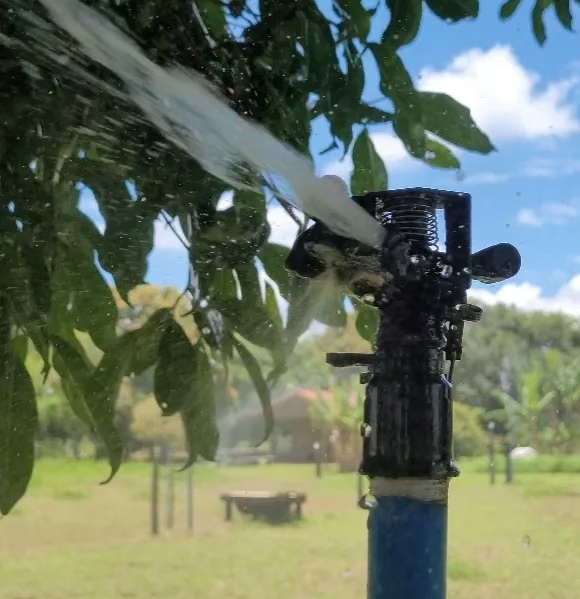
To choose a sprinkler for irrigation, check the flow rate and wetted diameter of the model at working pressure. Then, check whether the spacing distributes water well with the wind in the area and whether the application intensity is compatible with soil infiltration.
What does a sprinkler do and why does the model affect the result
The sprinkler divides the pressurized water jet into droplets. In fixed or conventional systems, the irrigation depth generally varies along the radius, and the overlapping of the jets helps to distribute the water more evenly. Two models with similar flow rates may have different distribution profiles due to the nozzle, jet trajectory and pressure. USDA-NRCS Sprinkler Irrigation Manual
To evaluate piping, pumping and division of the area into sectors, see how Perin sizes the sprinkler irrigation system.
Types of sprinklers for agricultural irrigation
Impact describes the turning mechanism. Sector indicates the turning area, barrel refers to size and low pressure describes the working condition. The same model can have more than one of these characteristics.
impact sprinkler
The jet moves an oscillating arm, which transmits impulses to rotate the sprinkler. There are versions with different nozzles and pressure ranges. To compare models, check the flow rate and range in the performance tables and follow the maintenance instructions for the chosen part. Rain Bird Impact Sprinkler Maintenance Guide
Sector sprinkler (partial circle)
Works within an arc. It can help limit water on edges near roads, buildings and canals. At the edge, check the application intensity and overlap with neighboring sprinklers. With the same flow rate and the same range, reducing the arc reduces the wetted area and can concentrate the application. Nelson Irrigation Project Guide
Hydraulic cannon
The cannon works with flows and ranges that can cover larger areas per position. There are models for fixed installations and winding reels. Pressure, droplet size and uniformity depend on nozzle assembly, trajectory, spacing and wind. Compare the range with the pressure required and the cost of pumping. Nelson Irrigation Cannon Catalog
Low pressure sprinklers and rotating emitters
Some rotating emitters use plates that divide and direct the jet, including pivots. Compare the models at the pressure for which they were designed and check the application intensity. Energy consumption also depends on the flow rate, the total head and the efficiency of the pump set. USDA-NRCS Sprinkler Irrigation Manual
In orchards that require application located close to the roots, it is worth comparing with the microsprinkler irrigation.
How pressure and nozzle define flow rate and droplet size
With the same fixed orifice nozzle, flow increases with pressure. The reach and distribution profile also change. Below the recommended range, the jet may fragment slightly and concentrate water in part of the wet area. Above the range, the jet can produce very fine droplets that are more susceptible to drift. Compare flow and range on the nozzle table, using the operating pressure on the sprinkler. USDA-NRCS Sprinkler Irrigation Manual
In a conventional semi-fixed sprinkler simulation, pressure and flow were the operational variables that most influenced the annual cost under the analyzed conditions. Consider both data when sizing the irrigation pump. Tambo et al., Agricultural Science Magazine
Spacing between sprinklers: wind and overlap
Use the wetted diameter stated for the nozzle and the working pressure as a starting point. The distance between sprinklers on the same line and the distance between lines are two design measurements. Wind can reduce the effective range and deform the distribution, even when the catalog diameter is sufficient on the paper. Use wind speed and direction data at irrigation times and confirm the grid with collectors in the field. Embrapa Vegetables, table 5
In a hydraulic cannon study, researchers simulated the overlap of profiles measured in the field. The triangular mesh covered more area per sprinkler in the simulated combinations, and uniformity varied with arrangement, spacing and pressure. Evaluate the arrangement along with the pressure and nozzle expected for the sector. Soccol et al., Brazilian Congress of Agricultural Engineering
Application intensity and soil
In a regular rectangular mesh with equal sprinklers, the nominal average intensity is the flow rate of a sprinkler in liters per hour divided by the product of the two spacings in meters. The result comes out in millimeters per hour, as 1 liter per square meter is equivalent to 1 mm. For example, 1,080 L/h divided by a grid measuring 18 m by 15 m corresponds to 4 mm/h. It is an example of calculation. The irrigation depth received at each point depends on the distribution. Embrapa Hortaliças, sizing chapter
Compare the predicted intensity with an infiltration rate representative of the sector. Slope, coverage, compaction and surface sealing affect the risk of puddling or runoff. Field assessment helps to check if there are sections where intensity needs to be reduced. See also the frequent errors in pasture irrigation. Calheiros et al., study on infiltration for sprinkler projects
How to choose the sprinkler for irrigation: decision guide
Before comparing models, gather industry data:
- Crop and area. Record the height of the crop, the sensitivity to the impact of drops and the area to be watered. To compare methods, see the types of irrigation.
- Flow and pressure available. On an existing system, confirm the pressure at the sprinkler with the section in operation. In a new project, add pressure losses and consider unevenness to determine the pump's working point.
- Wind. Survey direction and speed at the times you intend to irrigate.
- Soil and terrain. Use a representative infiltration rate and note slope and coverage.
- Water quality. Check filtration and compatibility with the intended nozzles.
- Area format. Identify edges and obstacles that may require arc or spacing adjustments.
- Operation. Compare travel time, parts availability and maintenance for each arrangement.
With this information, consult the performance table to compare pressure, flow, wet radius or diameter, recommended spacing and application intensity. Embrapa Vegetables
Uniformity and maintenance after installation
At commissioning, record pressure, flow and wind conditions, and deploy collectors to measure applied irrigation depth. The Christiansen uniformity coefficient (CUC) summarizes how much the measured irrigation depths deviate from the average. Compare the result with the goal defined for the project and check the pressures at critical points in the sector, including the predicted quota or pressure extremes. Embrapa Semiarid, evaluation of the sprinkler system · USDA-NRCS, uniformity criteria
During operation, watch for turning failures, leaks, and changes in range. To clean nozzles or check springs and washers, turn off the system, relieve pressure and follow the equipment manual. The Rain Bird impact sprinkler guide advises avoiding oil in the models described, which are lubricated by water. Rain Bird Guide
FAQ
What is the difference between a sprinkler and a micro sprinkler?
In fruit plants, the micro sprinkler usually applies smaller flows to a band or area close to the roots. Conventional sprinklers often use overlap to distribute water throughout the area. Consult the emitter sheet to check flow, pressure and wetted area. Embrapa Grape and Wine
Can I increase the pressure to make the sprinkler reach further?
Compare the radius indicated for each pressure in the table for the same nozzle. Increasing the pressure can increase the flow rate and change the distribution. Work within the manufacturer's range and confirm range and uniformity in the field. Embrapa Vegetables
How often do you change the nozzles?
Wear depends on operation and water. Measure the flow at the reference pressure and compare with the table or with a new nozzle of the same specification. Also check obstruction and pressure before attributing a deviation to wear. Follow the manual for cleaning or replacement. Embrapa Vegetables · Rain Bird Guide
Conclusion
Compare sprinklers by flow rate and working pressure distribution in the sector. Use wind, soil infiltration, and uniformity target to evaluate spacing. If a network already exists, also take the current nozzle data and pressure measurements.
To evaluate a project with the Perin Irrigação team, send the municipality, crop, approximate area and water source via WhatsApp (14) 99824-5219 or by email contato@perinirrigacao.com.br.
Sources consulted
Research carried out on 11/04/2026.
- MAROUELLI, W. A., SILVA, H. R., and SILVA, W. L. C. Sprinkler irrigation for vegetables. 4th ed., Embrapa, 2017. Embrapa Vegetables Manual
- USDA-NRCS. National Engineering Handbook, part 623, chap. 11, 2016. Sprinkler Irrigation
- TAMBO, F. L. R. et al. Influence of sprinkler operational parameters on the cost of conventional sprinkler irrigation systems. Agricultural Science Magazine, 52(2), 2021. Article in the UFLA repository
- CALHEIROS, C. B. M. et al. Definition of the infiltration rate for sizing sprinkler irrigation systems. Brazilian Journal of Agricultural and Environmental Engineering, 13(6), 2009. Article in SciELO
- SOCCOL, O. J. et al. Uniformity of application of irrigation water with hydraulic cannon under different arrangements and spacing. XXXIII CONBEA, 2004. I work in the Alice repository
- PINTO, J.M. Sprinkler irrigation system evaluation. Embrapa, 1987. Registration in the Infoteca-e repository
- CONCEÇAO, M. A. F. Irrigation of fruit trees by microsprinkler. Technical Circular 49, Embrapa, 2004. Embrapa Grape and Wine Circular
- RAINBIRD. Maintenance Guide: Impact Sprinklers. Manufacturer's Guide
- NELSON IRRIGATION. Big Gun Quick Coupling Design Guide and performance tables. Design Guide · Manufacturer's catalog
