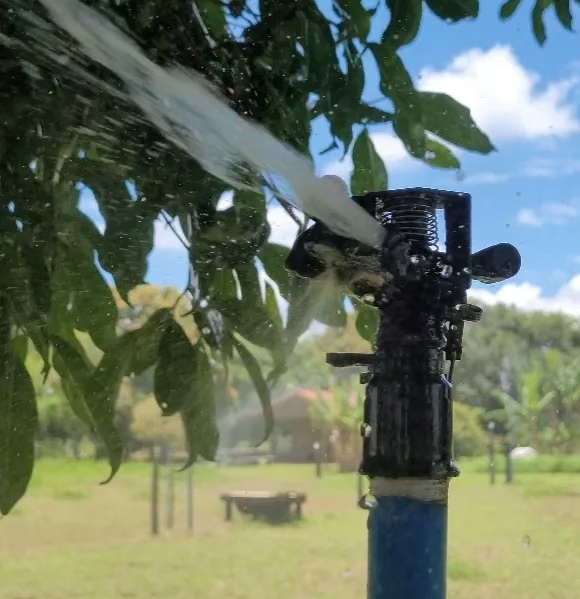
Before choosing the controller, confirm the flow and pressure that each sector needs and how the valves and pump should operate together. With this basis, automated irrigation can execute programming and record what occurred in the field. Soil sensors and remote access come in as needed on the farm.
What automated irrigation does (and what it doesn't do)
Automating irrigation means using a controller to activate equipment or monitor the operation. On the farm, it is worth separating three functions that can work together.
- Programming by time or volume. The controller performs programming by sector, with a defined duration or based on the measured volume, if the equipment is compatible.
- Control with sensors. Soil or climate readings can change the schedule when there is a management rule to interpret them. In a UFC trial, capacitive soil moisture sensors fed an algorithm that calculated irrigation time and controlled the pump and valves. Vasconcelos, UFC
- Remote supervision. Depending on the platform and available communication, the operator can monitor cycles, receive alarms and change programming remotely.
Management guides programming. To estimate the irrigation depth, consider crop demand, soil conditions and system performance. See the guide evapotranspiration in irrigation.
Components of an automated irrigation system
An Embrapa document on central pivot describes how sensors, controller and actuators communicate. These three elements also help to understand a sectorized system. Equipment and operating rules depend on the hydraulic design. Embrapa Corn and Sorghum, Documents 280
Controller or control platform
The controller performs programming, receives signals from compatible sensors and sends commands to equipment. The choice can range from a dedicated irrigation controller to a panel with programmable logic controller (PLC) and supervision software. The number of sectors and the need to integrate pump, meters and alarms help define the configuration.
Sector valves
Valves direct water to each sector. In solenoid-piloted hydraulic models, the controller activates the pilot and the water pressure moves the diaphragm. Check the model manual for the minimum operating pressure, flow range and pressure loss for the sector served. Filtration also needs to meet the conditions of the equipment.
Pump drive
The pump control needs to be integrated with the hydraulic conditions of the project. A frequency inverter allows you to vary the rotation when the flow and pressure demand changes. Its application depends on the operating range of the set and the needs of each sector. To evaluate the equipment, see how to choose the pump for irrigation.
Operation sensors
Pressure and flow meters allow you to compare the sector reading with the expected range. A deviation may indicate the need to check filters, valves, obstructions or leaks. A compatible hydrometer allows you to record the volume applied. A level sensor informs the controller of the condition of the catchment or reservoir, according to the rules defined in the project. Embrapa Corn and Sorghum, Documents 280
Handling sensors
Tensiometers, soil moisture sensors, rain gauges and weather stations help assess when and how much to irrigate. In a trial with a banana tree under micro-sprinkler in Ceará, failures of the automated system resulted in applications below and above expectations. The study helps to understand why installation, calibration when applicable and field checking make a difference. Macedo et al., Brazilian Journal of Irrigated Agriculture
To decide what to measure in your area, compare tensiometer and soil moisture sensor.
Communication
Sensors and actuators can communicate via cable or radio, depending on the equipment. Remote access can use a cellular network or another connection. Distance, terrain, coverage and dependence on external services influence the choice. Confirm with the supplier which functions remain available when the signal drops.
In what order to automate: a practical roadmap
Start with what needs to work in every irrigation. Use the sequence below as a reference to talk to the team responsible for the project.
- Check the hydraulics. Calculate the flow rate and working pressure of each sector, source availability, filtration and application uniformity. Identify necessary adjustments before automating.
- Define valve and motor pump control together. Specify the controller, valves, panel, and interlocks, which are the conditions that allow or block a command.
- Measure and test at commissioning. The responsible team must check flow and pressure in each sector, evaluate hydraulic transients during changes in operation and test the response to sensor, valve, energy or communication failures, according to the project. Record the expected ranges and predicted safe condition for each failure.
- Evaluate the integration of fertigation. With the base validated, check how the dosage by sector and operating and blocking conditions will be treated in the project. See the common errors in fertigation.
- Add handling sensors and remote supervision. Choose readings that help you make decisions and define which alerts require verification in the field.
If water availability is still uncertain, flow measurement is part of the initial diagnosis.
How to choose the irrigation controller
Take to the supplier a list of the sectors and equipment that need to be discussed with the controller. Compare the proposals by the following criteria.
- Sectors and expansion. Count the exits needed today and those planned for expansion.
- Programming by time or volume. To control by volume, confirm that the controller reads the meter output and how it reacts to a loss of signal.
- Inputs and security functions. Check the accepted sensors, which readings can trigger alarms and how the controller and panel implement the interlocks foreseen in the project.
- Fertigation. Check whether the controller integrates the doser and whether sector operation requires a dedicated module.
- Power and valves. Check available power and solenoid compatibility with controller outputs. Battery or solar panel can suit models designed for this application.
- Communication and alarms. Ask for a demonstration of what is recorded, how alerts arrive and which functions remain available without an external connection.
- Support and parts. Compare replacement availability, service and programming documentation.
Irrigation schedule and energy tariff
For eligible rural consumer units, the energy discount may apply to irrigation consumption at times formalized with the distributor. Confirm eligibility, scale, and effective date before programming the controller. MME Normative Ordinance No. 137/2026
Precautions in installation and operation
- Define the logic with the technical team. The order and activation times depend on the motor pump, valves, network and transient analysis. Ask for interlocks and fault response to be documented and tested at commissioning.
- Check the condition of the panel. Installation, electrical protection and restarting after a power outage must be assessed by qualified professionals for the farm's conditions.
- Record the performance of the sectors. Use commissioning reference readings to investigate deviations and maintain inspections of emitters, filters and sensors.
FAQ
Can you automate an existing irrigation system?
It is possible when the network and equipment are compatible or can be suitable. A avaliação começa pela pressão e vazão dos setores, pelas válvulas que a rede admite e pela integração do comando com o painel da bomba.
Does automated irrigation save water?
Automation helps to carry out management and, with measurement, monitor the volume applied. Para saber se houve economia, compare volumes medidos antes e depois em condições comparáveis, considerando área, cultura, chuva e demanda da lavoura.
Do I need internet at the property?
It depends on the equipment architecture. Some controllers perform programming locally, while remote supervision applications may be connection dependent. Confirm how programming, alarms, and resume work when the signal drops.
Is it worth it for small areas?
Compare the investment, maintenance and support with the watering frequency and time spent on the tasks you want to automate. Em uma horta ou estufa, por exemplo, a frequência das operações pode pesar mais na decisão do que a área total.
Conclusion
Before comparing controller brands, gather the flow and pressure of each sector, pump data and the functions you want to automate. Use this information to define equipment integration and what needs to be checked during commissioning.
If you want to evaluate the system with the Perin Irrigação team, send the municipality, crop, approximate area and water source via WhatsApp (14) 99824-5219 or by email contato@perinirrigacao.com.br. Also discover the service automation and fertigation.
Sources consulted
Research carried out on 11/03/2026.
- ANDRADE, C. de L. T. de et al. Components of a Smart Center Pivot Irrigation System. Embrapa Corn and Sorgo, 2024. Documents 280
- VASCONCELOS, H.S. Automation of a closed-loop irrigation system using a wireless network of capacitive soil moisture sensors. Master's thesis, Federal University of Ceará, 2013. UFC Institutional Repository
- MACEDO, A. B. M. et al. Performance of an automated irrigation system through soil water tension. Brazilian Journal of Irrigated Agriculture, v. 4, no. 2, p. 78–81, 2010. Embrapa Alice Repository
- BRAZIL. Ministry of Mines and Energy. MME Normative Ordinance No. 137, of June 8, 2026