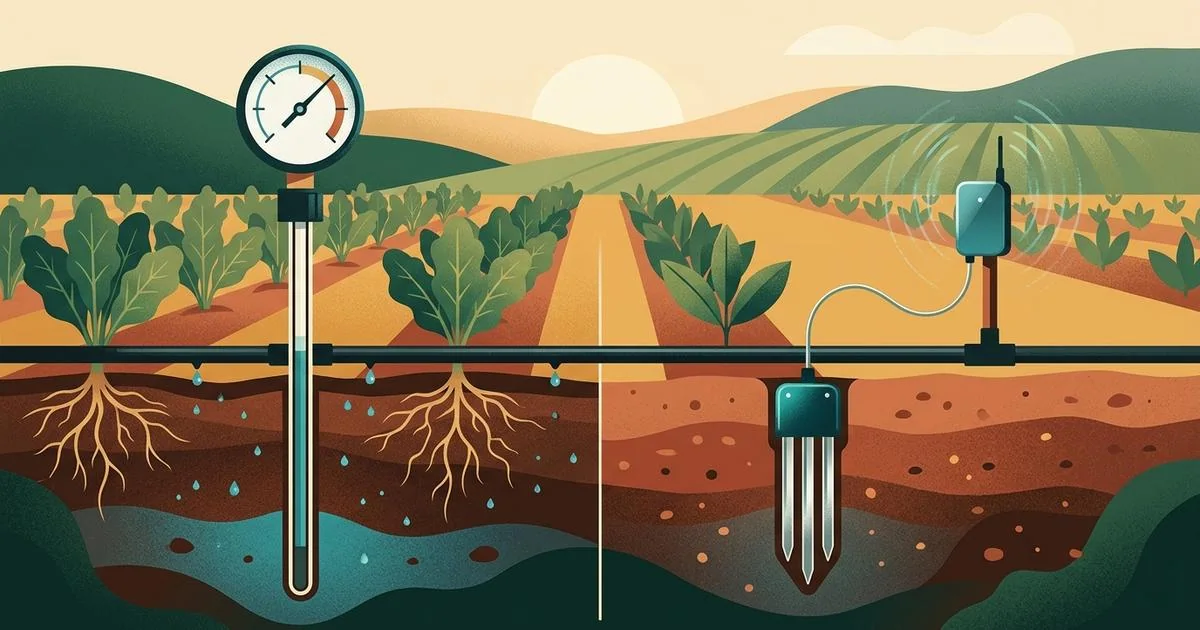
Summary: the tensiometer measures the strength with which the soil retains water; electronic sensors estimate how much water is in the soil and generally require local calibration. The choice depends on the handling humidity range, labor for reading and maintenance and integration with automation. In any case, the position of the instrument in the root zone is as important as the type of device.
Irrigating just according to the calendar can lead to two mistakes: irrigating while the soil is still damp or delaying until the plant is under stress. Measuring water in the soil replaces guesswork with measurement. The question when buying is whether it's worth another one. tensiometer for irrigation or a soil moisture sensor. Both are used for management, but they measure different magnitudes and require different care.
What each instrument measures
Tensiometer: the strength with which the soil holds water
The tensiometer is a tube filled with water with a porous ceramic capsule at the end and a vacuum gauge (or electronic transducer) at the top. According to the Embrapa Cerrados technical circular about the device, as the soil dries, water leaves the tube through the capsule and creates a vacuum, which the meter registers as tension. The higher the reading, the drier the soil and the more energy the roots use to extract water.
The usual unit is the kilopascal (kPa) or the centibar (cbar), which have the same numerical value. Two practical characteristics follow from this principle:
- No need for calibration for the type of soil. As the device directly measures tension, the same circular states that the type of soil does not cause appreciable differences in the reading.
- It has limited range. At around 80 kPa, the formation of vapor bubbles inside the tube (cavitation) begins, and this value is usually adopted as the operating limit. Altitude and water temperature reduce this limit.
Moisture sensors: how much water is in the soil
The most used electronic sensors in the field (TDR, FDR and capacitive) estimate the volumetric water content based on the soil's dielectric constant. Water has a much higher dielectric constant than that of soil minerals and air, so the reading changes as the soil moistens or dries, as explained in Embrapa Instrumentação's technical statement on capacitive sensors.
According to the same publication, TDR has high sensitivity, but is relatively expensive and sophisticated. FDR is simpler and cheaper, but depends more on salinity and soil type.
The point that weighs most is the calibration. A protocol published by Embrapa Milho e Sorgo in 2024 evaluated a commercial sensor and concluded that the factory calibration needed corrections for data use. In the study, the sensor systematically underestimated the humidity in the soils tested (the sandiest materials had the smallest deviations), and the publication associates the need for calibration with the characteristics of Brazilian tropical soils, such as high clay and iron content. Without calibration or validation in the area's soil, the reading can help track trends, but the absolute value may not be suitable for calculating water replacement.
Side by side comparison
| Criterion | Tensiometer | Humidity sensor (TDR, FDR, capacitive) |
|---|---|---|
| What it measures | Soil water tension (kPa) | Volumetric water content (%) |
| Calibration for soil | Not necessary, according to Embrapa Cerrados | Generally required for reliable readings |
| Useful range | Up to around 80 kPa | Defined by the model; reliability depends on calibration or validation on the ground in the area |
| Maintenance | Replenish water and remove air periodically | Check contact with the ground, cables, battery and communication |
| Reading | Manual (vacuum gauge) or electronic (transducer) | Electronics; continuous recording depends on the equipment and collection system |
| Integration with automation | Possible on models with transducer | Depends on model and controller compatibility |
When the irrigation tensiometer usually makes more sense
The tensiometer fits well when the crop is managed with relatively moist soil, within the range in which it works. The Embrapa Cerrados circular reproduces, adapted from an international reference, general activation ranges: 20 to 40 kPa for crops with greater economic value and sandy soils, 40 to 50 kPa as the usual value, 50 to 60 kPa for clayey soil and 70 to 80 kPa as the beginning of a deficit. These are general guidelines, not values to copy in any crop or soil.
In localized irrigation, such as drip and microsprinkler, frequent irrigations tend to keep the bulb wet with low voltages, which favors the tensiometer.
The limit appears when management foresees letting the soil dry beyond this range. In a study by Embrapa Hortaliças with tomatoes for processing in the Cerrado (Gama, DF), the recommendation for the vegetative and maturation phases was to irrigate when the tension reached 480 kPa, a value well above what a tensiometer can measure. In this test, the higher soil water tensions were measured with electrical resistance blocks. In these cases, the instrument loses its usefulness precisely in the most important decision.
When a humidity sensor usually makes more sense
Electronic sensors make the most sense when:
- management foresees periods of drier soil, outside the tensiometer range;
- the property wants continuous recording and remote monitoring;
- the readings will feed a automation, with activating sectors and pumping based on data;
- There is provision to calibrate the sensor on the ground in the area.
The sensor only guides the decision when it is known which humidity corresponds to the replacement point in that soil. Without this reference, the graph shows varying humidity, but does not indicate when to irrigate.
Where to install: a decision that weighs as much as the type of device
A poorly positioned instrument measures soil that the plant is not using. Technical circular 109 from Embrapa Mandioca e Fruticultura recommends installing the sensors in the root zone delimited by the distance and depth where 80% of water extraction by the roots occurs, and avoiding places with negligible absorption, such as between rows or between plants.
This zone changes with the crop, irrigation system and frequency. The examples in the publication show the variation:
- Banana under micro-sprinkler (irrigation every 2 days): up to 0.70 m from the plant and 0.20 to 0.50 m deep.
- Papaya under drip (every 2 days): up to 0.40 m from the plant and 0.20 to 0.30 m deep.
- For all fruit plants mentioned, except pineapple, the greatest root activity occurred between 0.20 and 0.40 m away from the plant.
These numbers apply to the conditions of the original experiments. More frequent irrigations tend to concentrate roots close to the surface, and more spaced irrigations favor deeper roots. Therefore, the position foreseen in the project must be checked in the field.
Other recommendations from Embrapa circulars:
- Use representative measurement points. The Embrapa Cerrados circular recommends at least three tensiometers per area differentiated by soil, crop, slope and irrigation. For grains in the described scenario, there are batteries at depths of 10, 20 and 30 cm.
- Install a second sensor at the bottom edge of the effective root depth. It helps indicate when to stop irrigation.
- Ensure firm contact between the capsule or stem and the ground.
Maintenance and reading on a daily basis
The tensiometer requires routine. Embrapa Cerrados recommends topping up the water and removing the air every three reading days or whenever there is suspicion of accumulated air, preferably right after irrigation, and taking at least three readings between one irrigation and another. Lids exposed to the sun can crack and vacuum gauges can rust when water enters, which compromises the measurement.
In electronic sensors, the routine is to check cables, batteries, communication and whether the sensor is still securely placed on the ground. In both cases, writing down readings, dates and irrigation times creates the history that allows you to adjust management.
FAQ
Does the tensiometer measure soil moisture?
Not directly. It measures the tension with which the water is held. Different soils can have the same humidity and very different tensions, and it is the tension that indicates the root's difficulty in extracting water.
What is the right voltage to irrigate?
There is no single value. It depends on the crop, the stage of development, the soil, the irrigation system and the depth of the reading. The tracks published by Embrapa serve as a starting point, to be adjusted with technical support.
Humidity sensor without calibration is suitable for irrigation?
It can be used to monitor trends, but the absolute value may have errors, as occurred with the commercial sensor evaluated in the Embrapa Milho e Sorgo protocol, which underestimated the humidity in the soils tested. To decide how much water to replace, you need to calibrate or validate the readings on the soil in the area.
Conclusion
The choice starts with the humidity range in which the crop will be managed and the routine that the property can maintain. The tensiometer for irrigation is simple, requires no soil calibration and works well with moist soil, but stops measuring around 80 kPa and requires frequent maintenance. For electronic sensors, check the measurement range, calibration or validation on the ground in the area and compatibility with automation. In both cases, the position in the root zone decides whether the reading represents the conditions the roots are in.
If you are planning irrigation monitoring in your area or want to integrate sensors into an existing system, the Perin Irrigação team can help evaluate the case. Inform the municipality, crop, approximate area and water source via WhatsApp (14) 99824-5219 or by email contato@perinirrigacao.com.br.
Sources consulted
Research carried out on 10/19/2026.
- AZEVEDO, J. A. de; SILVA, E. M. da. Tensiometer: practical device for controlling irrigation. Planaltina, DF: Embrapa Cerrados, 1999. (Technical Circular, 1).
- COELHO, E. F.; SIMÕES, W. L. Where to position soil moisture and water tension sensors close to the plant for more efficient irrigation water management. Cruz das Almas, BA: Embrapa Mandioca e Fruticultura, 2015. (Technical Circular, 109).
- RABELLO, L.M.; VAZ, C. M. P.; TORRE NETO, A. Capacitive sensor for probing moisture in the soil profile. São Carlos, SP: Embrapa Instrumentação Agropecuária, 2005. (Technical Communication, 71).
- VIANA, J. H. M. Protocol for calibrating and measuring soil moisture sensors. Sete Lagoas, MG: Embrapa Milho e Sorgo, 2024. (Research and Development Bulletin, 262).
- MAROUELLI, W. A.; SILVA, H. R. da. Parameters for sprinkler irrigation management on tomato plants for processing in the Cerrado Region. Brasília, DF: Embrapa Hortaliças, 2009. 28 p. (Research and Development Bulletin, 49).