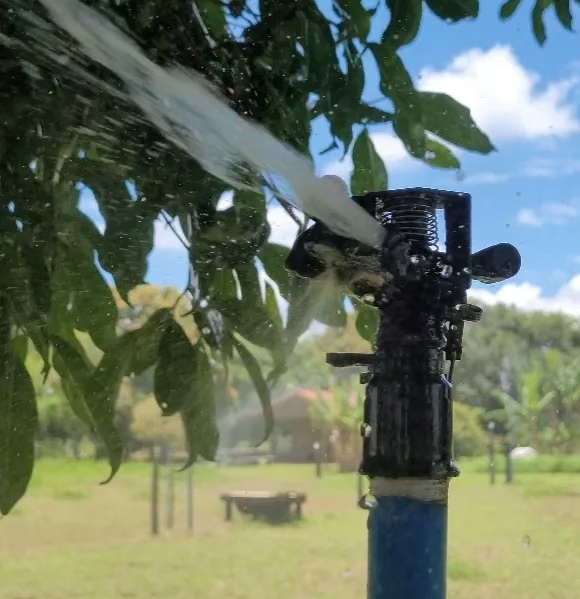
Summary: micro-sprinkler distributes water around the emitter; drip apply to spots that can form wet streaks. The choice depends on the volume of soil that needs to receive water, the crop and the conditions of the area. Compare methods in banana, citrus and avocado orchards and see what to check before defining the system.
What is microsprinkler irrigation
Microsprinkler is a form of localized irrigation that launches water through the air over a defined area. The emitter can be on a rod or in another mounting provided for the application. The microtube connects to the lateral line.
Embrapa Technical Circular 49, published in 2004, describes equipment from 100 to 300 kPa and 20 to 140 L/h. They are references to that material, not a mandatory range for all current models. Pressure, flow and range need to be checked in the technical data sheet of the chosen emitter.
Types of micro sprinklers
There are emitters with a rotor and others with a static diffuser. The book Localized irrigation systems, from UFGD, distinguishes these constructions and presents examples of their scope. To choose, compare:
- Rotary ("ballerinas"): use a moving part to distribute the jet. The radius depends on the nozzle assembly, rotor and installation conditions.
- Diffusers (static): distribute the jet without rotation. The standard can serve a specific area or sector, depending on the model.
- Pressure-compensating versions: regulate flow within the specified pressure range. They do not correct insufficient pressure or eliminate hydraulic calculations. See also the principle of pressure-compensating dripper.
The installation height also modifies the wetting profile. Changing it in the field requires checking the result, rather than assuming that greater range will always be better.
Microsprinkler or drip irrigation: what changes in practice
The guide Types of irrigation presents the methods. Here, the comparison deals with the agronomic and operational criteria for an orchard; The choice of equipment and services is part of the project.
Wet area and root development
The wet area must cover the region of roots that participates in absorption. A wider application alone does not ensure better growth: it matters where the water arrives and how it is distributed in the profile.
A percentage of wet area relates the area served to the area occupied by each plant. Embrapa's material on citrus uses the range of 33% to 67% as a practical historical reference, but presents conditions in which lower values are acceptable. It is not a universal goal for every crop or property. Texture, soil layers, rainfall and arrangement of emitters change this assessment.
Soil texture
In a sandy profile, lateral distribution of water may be limited. This requires checking the volume of soil covered and the frequency of irrigation, whatever the method.
- For citrus, Embrapa describes the larger wetted area as a reason to evaluate microsprinklers on sandy soils. The same material allows expanding the number of drippers to cover the required area.
- For BRS Princess, the 2018 circular favors micro-sprinkler and restricts drip irrigation on sandy soil under the conditions studied. This indication should not be transformed into a general prohibition: another Embrapa material about bananas features drip arrangements for a sandy texture.
The design needs to know the actual profile, including layers of different textures and drainage. Just classifying the soil as “sandy” or “clayy” does not end the choice.
Application efficiency
Embrapa's circular on BRS Princesa uses 0.85 for microsprinkler and 0.90 for drip in its calculations. These numbers are hypotheses of that example, not measurements of its property nor an efficiency guaranteed by the name of the method.
In the real area, losses and management need to be evaluated. Application efficiency is also not to be confused with flow uniformity. See how efficiency enters into the gross irrigation depth estimate in the article about evapotranspiration in irrigation.
Wind and evaporation
In micro-spraying, the path through the air leaves the application exposed to wind and evaporation. The intensity of the losses depends on the climate, the emitter and the operation. Observe the jet displacement and water distribution under the conditions in which the system will be used; do not assume a fixed percentage of loss.
Clogging and filtration
The UFGD book lists the lower susceptibility of some micro sprinklers to the wider nozzle. This does not mean there is no clogging. Water passage, equipment construction, and contaminants need to be considered.
Filtration must meet water quality and manufacturer specifications. Consult the guide irrigation filters to understand the criteria, without choosing the filter just by the type of issuer.
Flow per emitter and pumping
The nominal flow of a micro sprinkler usually exceeds that of an individual dripper, but the number of emitters and operating time also change. The useful comparison is the total flow of each sector, along with the service pressure and desired distribution.
Therefore, changing one method for another requires reviewing piping, filtration, sectorization and pumping. The bill is not limited to replacing parts at the end of the line.
Comparison Summary
| Criterion | Micro-sprinkler irrigation | Drip irrigation |
|---|---|---|
| Wetting | Distribution around the emitter; check the applied profile | Points that can form a band; check the volume of soil served |
| Sandy soil | Evaluate reach, distribution and drainage | Evaluate number and position of transmitters and frequency |
| Medium or clayey soil | Check application and infiltration | Check lateral distribution and risk of excess |
| Efficiency in the 2018 BRS Princesa example | 0.85 hypothesis, no field guarantee | 0.90 hypothesis, no field guarantee |
| Wind | Can shift distribution by air | The jet does not travel through the air in the same way |
| Clogging | Requires water and filtration compatible with emitter | Requires water and filtration compatible with emitter |
How pick appears in banana, citrus and avocado
Banana. Embrapa presents different arrangements depending on spacing, soil and plant stage. The BRS Princesa circular also shows that the microsprinkler and drip behavior depends on the wetted area and the configuration of the lines. These results do not define a winner for every banana plantation. See the criteria for banana irrigation.
Citrus. Embrapa materials discuss the position of micro sprinklers and the possibility of distributing drippers at more points or lines. The objective is to cover the soil exploited by the roots throughout the development of the orchard. Do not copy a number of emitters per plant without considering soil, spacing and management. See also irrigation for lime.
Avocado. The California Avocado Commission describes roots close to the surface and sensitivity to waterlogging. This foreign reference does not provide a depth of design for Brazilian orchards. UC IPM relates excess humidity and poor drainage to favoring rot due to Phytophthora; Choosing an issuer does not eliminate this risk. Evaluate drainage, distribution and water management.
In Perin's portfolio, Fazenda Santa Clara, in Timburi/SP, records pressure-compensating microspraying in avocado. It is a published case, not a configuration to be transferred to another area. See also irrigation for avocado.
Design and operation precautions in micro-sprinkler
- Position and height: Check where the water arrives and whether the emitter remains installed as intended.
- Interferences: observe vegetation, trunks and obstacles to the jet. The page microsprinkler presents Perin's design approach.
- Insects and spiders: Check for blocked outlets and locked rotors during inspections.
- Uniformity: Sampling flow and pressure helps identify differences between emitters. The distribution within the wetted area requires another assessment, such as collecting precipitation at points around the emitter. A flow test alone does not prove this distribution. O drip uniformity test explains flow assessment; its protocol should not be fully transferred to microsprinkler.
FAQ
Does micro sprinkler use more water than drip? There is no single answer without evaluating the area. Crop demand, wetted area, losses, uniformity and operating time are included in the comparison. An efficiency used in a technical example does not measure the consumption of your system.
Can I exchange drippers for micro sprinklers in the same system? The change requires recalculating flow by sector and pressure, in addition to checking pipes, filters and pump. Compatibility of connections does not guarantee hydraulic operation.
What is the best option for sandy soil? Microsprinklers deserve evaluation due to their wider distribution. Drip also needs to be analyzed by wet volume, number of emitters and frequency. Recommendations from a crop and a study do not replace the assessment of the local profile.
Conclusion
Compare the systems based on what your area needs: water distributed in the root region, operation compatible with the soil and loss control. Crop, spacing, water quality, wind and pumping need to be evaluated together.
If you are planning a new orchard or considering changing systems, the Perin Irrigação team can help you compare the alternatives. Send municipality, crop, approximate area and water source via WhatsApp (14) 99824-5219 or by email contato@perinirrigacao.com.br.
Sources consulted
Research carried out on 10/30/2026.
- CONCEÇAO, M. A. F. Irrigation of fruit trees by microsprinkler. Technical Circular 49. Bento Gonçalves: Embrapa Uva e Vinho, 2004.
- COELHO, E. F. et al. Irrigation of banana cultivar BRS Princesa. Technical Circular 126. Cruz das Almas: Embrapa Mandioca e Fruticultura, 2018.
- EMBRAPA. Irrigation. In: Organic production system for banana cultivation. 3rd edition.
- COELHO, E. F.; OLIVEIRA, A. S.; MAGALHÃES, A. F. J. Irrigation and fertigation in citrus. Technical Circular 38. Cruz das Almas: Embrapa Mandioca e Fruticultura, 2000.
- COELHO, E. F. et al. Irrigation and fertigation in citrus crops (chap. 14). Embrapa.
- BISCARO, G. A. (org.). Localized irrigation systems. Dourados: Editora UFGD, 2014.
- CALIFORNIA AVOCADO COMMISSION. Irrigating avocados (AvoFacts).
- UC IPM – University of California. Avocado: Phytophthora root rot.