Summary: avocado trees need water during flowering, fruit set and fruit growth, but their roots are sensitive to oxygen deficiency in the soil. Waterlogging can damage the roots and favors root rot caused by Phytophthora cinnamomi. Management combines drainage, irrigation, healthy nursery plants and measures to prevent the pathogen from spreading. Learn how to assess water conditions in the orchard and recognize situations that require diagnosis.
Why is the avocado tree so sensitive to excess water?
A review of the crop's water relations (Carr, 2013) describes avocado trees as shallow-rooted: some roots extend beyond 1.5 m, but most fine roots are in the upper 0.60 m of soil. New Zealand Avocado describes a higher concentration in the upper 30 cm under the conditions covered by its publication. These values do not specify a fixed design depth: check root distribution in the orchard itself.
According to New Zealand Avocado, feeder roots have no root hairs and develop best in loose, well-aerated soil. Carr's review adds that flooding and oxygen depletion can damage roots even in the absence of pathogen-induced root rot.
The University of California describes Phytophthora cinnamomi as an oomycete, a fungus-like organism. Its zoospores move through soil water; contaminated nursery plants, soil adhering to equipment and footwear, and water moving through infested areas can also spread the pathogen. Excess soil moisture and poor drainage favor the disease, but do not fully explain it on their own.
UC IPM identifies irrigation as a central component of integrated management. Adjusting irrigation helps reduce conditions favorable to the disease; it neither eliminates the pathogen nor guarantees a disease-free orchard.
November: fruit set and the arrival of the rains
November does not correspond to the same growth stage in every orchard. Water needs follow the trees' actual development. The California Avocado Commission highlights flowering, fruit set and rapid fruit growth as stages when water supply requires particular attention. A study in Jardinópolis, São Paulo, involving 'Geada', 'Fortuna' and 'Quintal' reported flowering between July and September under the conditions evaluated. This calendar should not be applied automatically to another cultivar, region or year.
Embrapa warns of damage from both dry spells and excessive rainfall during flowering and fruiting. After rain, check soil water replenishment and adjust the irrigation schedule. The season or the accumulated rain gauge total alone does not establish that the entire root zone has received enough water.
Before irrigation: soil, drainage and planting
Before installing irrigation, assess how water enters, moves through and drains from the site:
- Drainage: Embrapa recommends deep, well-drained soils. Assess texture and structure throughout the soil profile; clay content alone does not establish how long water will remain accumulated.
- Preparation and planting: soil berms, measures to alleviate soil compaction, or drains are options to assess according to the problem. A berm must allow water to drain without ponding or erosion; it does not replace an assessment of the site.
- Mulching: coarse organic material beneath the canopy can be part of the management approach. Keep it away from the trunk and monitor soil moisture beneath the mulch before irrigating again.
- Nursery plants and movement around the orchard: use planting material with a known plant health history and assess tolerant rootstocks with local technical guidance. Tolerance does not mean immunity. Avoid moving soil and water from infested areas to healthy areas.
Microsprinkler or drip irrigation for avocado trees
The irrigation design must deliver water to the active root zone without keeping individual areas saturated. Check the actual distribution in the soil and reassess it as the trees grow.
Microsprinkler irrigation beneath the canopy. The California Avocado Commission reports that low-flow microsprinklers beneath the trees are widely used in that state. This describes the Californian context; selecting emitters and the wetted area for your orchard depends on the soil, root distribution and the ability to apply water without ponding.
Drip. Drip irrigation can serve the orchard when the location and number of laterals and emitters suit root distribution and water movement in the soil. A layout suitable for a young tree may need to be expanded later. There is no universal number of drippers per tree: check the wetted strip and the design flow rate, without concentrating the entire water application at just a few points.
The choice depends on the age of the orchard, soil, available water and topography. The differences between the two systems are in Microsprinkler irrigation: how it works and when to choose it over drip.
There is also the quality of the water. Carr's review highlights that the avocado tree is particularly sensitive to salinity, especially chloride, with differences between rootstocks. Before the project, it is worth doing a water analysis for irrigation.
Avocado irrigation: how to decide when and how much to irrigate
Estimate demand from weather data
Water demand can be estimated from crop evapotranspiration (ETc = Kc × ETo). Table 12 of FAO Irrigation and Drainage Paper 56 gives Kc values of 0.60, 0.85 and 0.75 for the initial, mid-season and late-season stages of avocado with no ground cover. These are reference values for the conditions described by the source: tree age, canopy and ground cover, spacing and climate must be considered when selecting the coefficient. ETo and Kc must be compatible with the method and the same calculation period. See the step-by-step explanation in Evapotranspiration in irrigation: how to use ETo and Kc to estimate how much to irrigate.
Check soil moisture
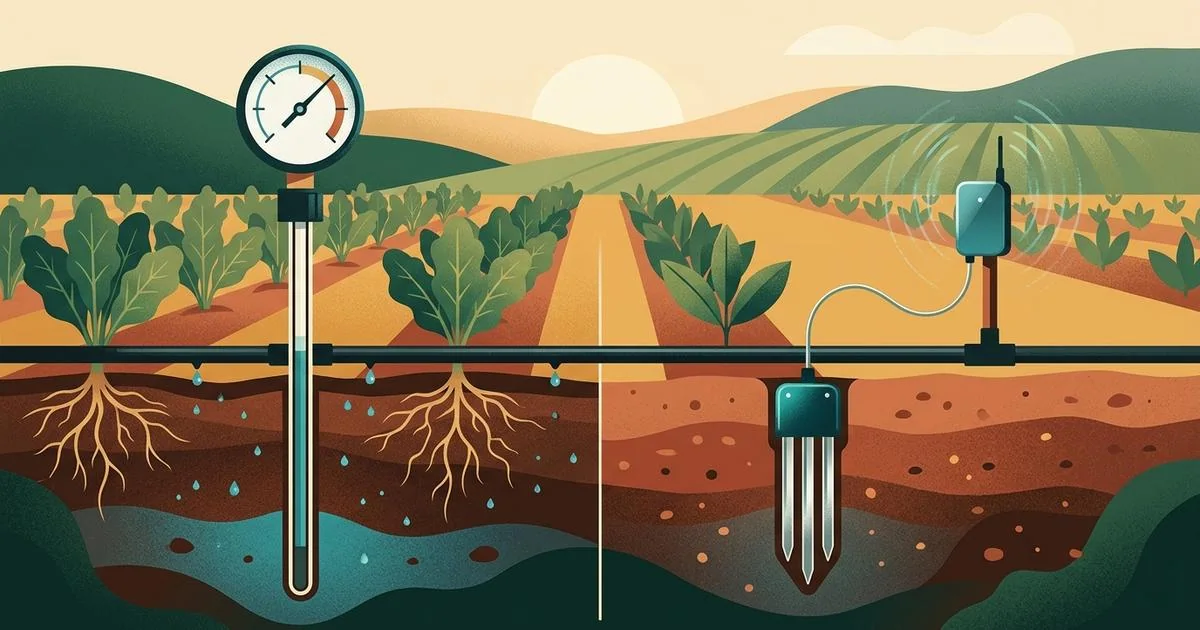
Weather data provide an estimate of water use; representative soil measurements help check replenishment. Californian extension guidance uses tensiometers at two depths to monitor the root zone and water reaching deeper layers. Sensor locations, depths and reading thresholds must be set for the soil and roots in the orchard itself. See how to choose between instruments in Tensiometer or soil moisture sensor: which one to use to decide when to irrigate.
Two checks help avoid excess water:
- Check water needs before irrigating again. If the root zone still contains sufficient water, postpone or reduce irrigation according to the water balance and monitoring results. Avoid prolonging saturation.
- Track readings from the deeper sensor over time. Persistently high soil moisture may indicate percolation or slow drainage. Compare rainfall, irrigation events and sensor location; an isolated reading does not establish that the irrigation depth was excessive.
Hypothetical example
Illustrative assumptions, not applicable to another area without adjustment: a mature orchard, ETo of 5 mm/day and Kc of 0.85, the FAO reference for the mid-season stage of avocado with no ground cover. Estimated ETc would be 0.85 × 5 = 4.25 mm/day. This Kc is not a rule for every orchard in November.
If the rain gauge recorded 20 mm the previous day, you still need to check how much water entered and remained in the root zone. Reduce or suspend irrigation if the water balance and representative measurements indicate sufficient water; total rainfall alone is not enough to make that decision.
To convert a water depth into liters per plant, the reference area must match the calculation: a depth expressed over the field uses the area allocated to each plant by the planting spacings. The actual wetted area informs water distribution and root assessment, but does not automatically replace that reference area in the calculation. Operating time depends on the volume to replenish, the assumed efficiency and the flow rate per plant; do not apply a localized-irrigation reduction twice.
Warning signs in the orchard
The University of California describes typical symptoms of root rot:
- small, light green or yellowish leaves, sometimes with necrotic tips;
- wilting of leaves even when the soil under the tree is moist;
- shoot tip dieback, exposing branches and fruit to the sun;
- production of many small fruits;
- fine feeder roots that are dark, brittle and sparse.
These signs alone do not identify the cause. If trees wilt while the soil is wet, check moisture throughout the soil profile and seek an agronomic diagnosis, with appropriately guided root and soil sampling. Increasing irrigation in response to the canopy's appearance can prolong waterlogging.
An Esalq/USP study evaluated treatments in non-irrigated 'Hass' avocado trees in Limeira, São Paulo. Trees showed partial recovery in treatments involving potassium phosphite; lime or gypsum alone did not restore the plants under the trial conditions. This is not a prescription for another orchard. Product choice, applicable registration, dose and application method require a specific professional assessment. No treatment replaces appropriate water and drainage management.
FAQ
Does the avocado tree need irrigation throughout Brazil?
Not necessarily. A 1998 Embrapa technical circular cites around 1,200 mm of well-distributed annual rainfall as a reference and highlights the need for irrigation in drier conditions. That annual total does not replace a local water balance: rainfall distribution, soil water storage and crop demand determine whether supplemental irrigation is needed.
Is it better to irrigate little and often?
Soils with less water storage may require smaller, more frequent applications. The irrigation interval should be based on water use, rainfall and root-zone monitoring. Repeated irrigation that keeps the soil saturated favors oxygen deficiency and conditions for disease; frequent irrigation alone does not establish inadequate management.
Conclusion
Good avocado irrigation replenishes the water needed without prolonging saturation. It starts with site selection and drainage, continues with distribution in the root zone, and depends on ongoing weather and soil monitoring. Irrigation is part of root rot prevention, alongside healthy nursery plants and measures to avoid spreading the pathogen. During rainy periods, postponing irrigation should be as well supported by evidence as switching the system on.
If you are installing or reassessing orchard irrigation, the Perin Irrigação team can help evaluate a suitable system; visit our page on irrigation for avocado. To start a conversation, share your municipality, crop, approximate area and water source via WhatsApp (14) 99824-5219.
Email: contato@perinirrigacao.com.br.
Sources consulted
Sources consulted on November 13, 2026.
- ALLEN, R. G.; PEREIRA, L. S.; RAES, D.; SMITH, M. Crop evapotranspiration: guidelines for computing crop water requirements. FAO Irrigation and Drainage Paper 56, Table 12. FAO, 1998.
- CARR, M. K. V. The water relations and irrigation requirements of avocado (Persea americana Mill.): a review. Experimental Agriculture, v. 49, no. 2, p. 256-278, 2013. Editor's summary:
- UNIVERSITY OF CALIFORNIA, Statewide IPM Program. Avocado Pest Management Guidelines: Phytophthora Root Rot.
- UNIVERSITY OF CALIFORNIA, Statewide IPM Program. Avocado root rot or Phytophthora root rot (Home & Landscape).
- SILVA, S. R.; CANTUARIAS-AVILÉS, T.; BREMER NETO, H.; MOURÃO FILHO, F. A. A.; MEDINA, R. B. Management of root rot in avocado trees. Revista Brasileira de Fruticultura, v. 38, no. 4, e-175, 2016. DOI: 10.1590/0100-29452016175.
- DUARTE, O. R. A cultura do abacateiro. Technical Circular 4. Embrapa CPAF-Roraima, 1998.
- ZANATA, R. M. P.; CAZETTA, J. O.; BARBOSA, P. W. G. Seasonal nutrient content variation in avocado leaves of 'Geada', 'Fortuna' and 'Quintal' genotypes. Revista Brasileira de Fruticultura, v. 45, e-425, 2023. DOI: 10.1590/0100-29452023425.
- CALIFORNIA AVOCADO COMMISSION. Irrigating Avocado Trees.
- CALIFORNIA AVOCADO COMMISSION. Checking Soil Moisture in Avocado Groves.
- BENDER, G.; FABER, B. Irrigation. In: Avocado Production in California, Book 2: Cultural Care, chap. 1. University of California Cooperative Extension, [n.d.].
- NEW ZEALAND AVOCADO. Roots – Back to basics.