Summary: citrus irrigation management combines the orchard's growth stage, climatic demand, soil water and system performance. Budbreak, flowering, fruit set and early fruit development require attention to water deficits. The rest period and ripening have different conditions, but that does not automatically justify suspending irrigation. The schedule should reflect the orchard, rather than just the month of the year.
The guidance below helps organize water management in orange, lemon and lime orchards, including Tahiti lime. The scion–rootstock combination, plant age, soil and climate all need to be included in the technical assessment.
What changes at each stage of the orchard's cycle
Technical publications describe differences in sensitivity to water deficits throughout the cycle. One identifies a critical period from flowering until the fruit reaches approximately 2.5 cm in diameter. This stage needs to be observed on the plants: flowering in September does not, by itself, establish the condition of the fruit in November.
| Observed stage | What to monitor | Management decision |
|---|---|---|
| Budbreak, flowering and fruit set | Water available to the roots, rainfall and irrigation zone performance. | Avoid a schedule that allows the orchard to reach a water deficit too severe for this stage. |
| Early fruit development | Fruit retention and growth, climatic demand and moisture in the soil profile. | Check water replenishment and distribution across the irrigation zones. |
| Fruit expansion and ripening | Fruit growth and quality, soil conditions and climatic demand. | Adjust management to the production objective and plant condition, without assuming that irrigation can be dispensed with. |
| Rest period or partial dormancy | Climate, water status, plant age and production strategy. | Assess whether a controlled water-deficit strategy is technically appropriate. |
Lower sensitivity at one stage does not mean fixed daily water use or the same requirement in every region. Rainfall also needs to be assessed for its effective contribution to the root zone.
The rest period does not automatically mean turning off irrigation
Under subtropical conditions, cold can contribute to floral induction; under tropical conditions, water availability may play a different role. The sources discuss controlled water deficits in specific situations, with risks if the severity of the deficit or the timing of irrigation resumption is inappropriate.
This strategy requires technical supervision. Before reducing irrigation, assess the climate, soil water reserves, scion–rootstock combination, plant age and plant condition. The timing of rehydration is also part of the decision. A research report that suspends irrigation for a certain number of days does not define the schedule for another orchard.
How much to irrigate: distinguish ETc, applied depth and volume
The relationship ETc = ETo × Kc estimates crop evapotranspiration under the conditions represented by the coefficient. ETo and ETc can be expressed in millimeters per day. Evaporation measured in a Class A pan must be converted to ETo using the pan coefficient, Kp; the pan reading is not directly equivalent to ETo.
Kc varies with the orchard and the study conditions. The chapter on subtropical fruit crops reports, for example, a mean Kc of 0.71 for Pêra orange in Casa Branca/SP. For a Tahiti lime study in Piracicaba/SP, it reports seasonal means close to 0.24 in winter and 0.65 in summer. These results come from specific situations and help illustrate variability; they are not a ready-made curve for every planting.
To turn the estimate into an irrigation decision, consider effective rainfall, water stored in the soil and application losses. In localized irrigation, adjustments for ground cover must be consistent with the calculation method, avoiding applying the same adjustment twice.
If the question is how many liters a plant needs, the area to which the water depth refers also needs to be defined. 1 mm over 1 m² equals 1 liter. This conversion does not determine Kc, the number of emitters or how long an irrigation zone should run. Learn about evapotranspiration and how to use the Class A evaporation pan.
When to irrigate: check the soil profile
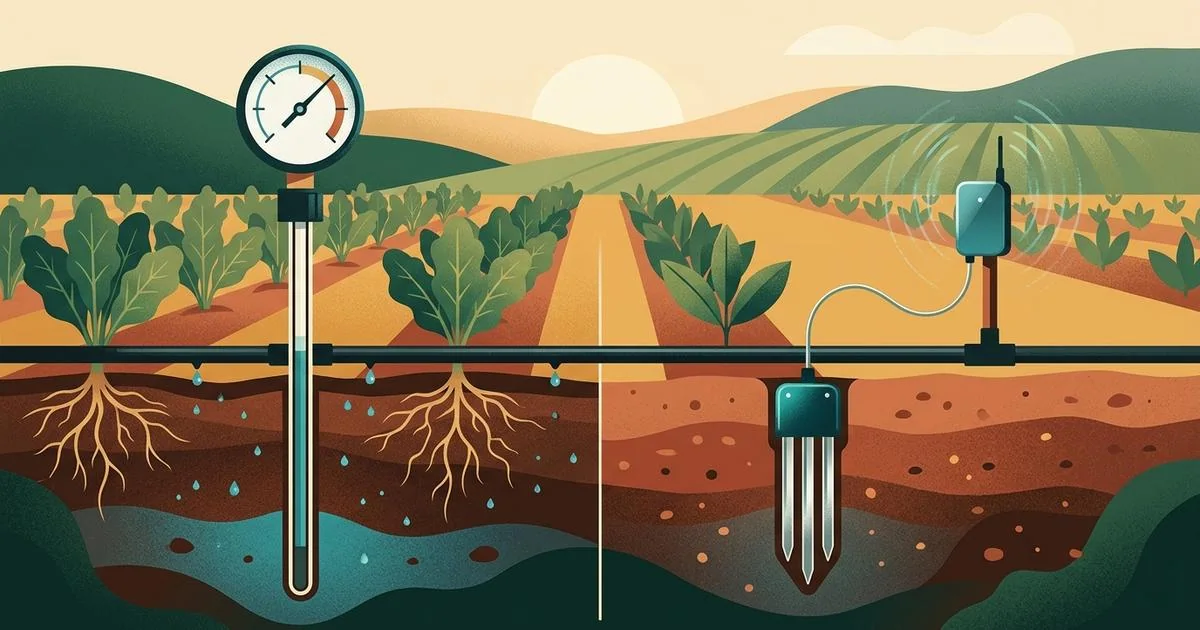
Sensors help check whether the schedule represents the zone explored by the roots. Their position and depth need to reflect root distribution, the wetted soil volume and differences in soil conditions. A single reading at an unrepresentative point can conceal dry or excessively wet areas.
The sources describe different sensor layouts. These examples should be adapted to the site; depth and distance from the trunk are not universal measurements. Also record how each instrument displays its result: matric potential may have a negative sign, while soil water tension is often expressed as a positive magnitude. The numbers must be interpreted according to the instrument's convention.
Another variable is the fraction of available soil water depleted before irrigation, denoted by f in the references. The 2011 citrus chapter gives 0.30 to 0.35 for the critical period and 0.50 for other stages. These historical examples require assessment of the soil, demand and plant stage. A fraction of 0.30 means that 30% of the available water has been depleted; it is not a reading of 30 kPa and does not mean that 30% of the water remains.
See how these variables are used to determine the irrigation interval and compare tensiometers and soil moisture sensors.
Drip or micro-sprinkler irrigation: design for the wetted root zone
Drip and micro-sprinkler irrigation are used in citrus orchards. The comparison involves water distribution in the soil, roots, spacing, available flow and orchard operations. A wetted-area percentage cited in a publication, or an emitter layout described for a particular plant age, does not replace system design.
For drip irrigation, assess the number and layout of laterals, emitter spacing and flow rate, and moisture distribution. For micro-sprinkler irrigation, check the throw radius, position and obstructions to the spray. Both systems require pressure and filtration compatible with their components.
Plan for orchard development from the start: increasing the number of emitters or changing operations alters the flow required by the irrigation zone. Pump, pipe and filtration capacity must be checked before expansion. The guide to micro-sprinkler irrigation helps with this comparison.
Rainfall and fertigation also require adjustments
After rainfall, check whether the water reached the monitored soil profile before keeping the previous schedule. Excess water and inadequate aeration harm roots. Research observations of waterlogging do not establish a safe number of days for an area to remain saturated.
Fertigation needs to follow nutritional requirements, the orchard's growth stage, and soil and leaf analyses. Published schedules for particular flowering and harvest dates are contextual examples, rather than ready-made dates or doses for another property. Operations also require compatibility between water, fertilizers and equipment. See the steps to avoid fertigation errors.
FAQ
How much water does an orange, lemon or lime tree need each day?
The volume depends on the climate, plant stage and size, soil, reference area and system. Estimate demand, check water reserves in the soil profile and convert the water depth for the corresponding area. Actual emitter flow rates are needed to determine operating time.
Can I suspend irrigation in winter?
The decision depends on the orchard's condition and the agronomic strategy. A rest period, cold weather or the arrival of winter does not automatically call for suspension. Any water-deficit strategy needs appropriate monitoring and resumption of irrigation.
Organize the data before changing the schedule
Record plant stage, rainfall, soil readings, pressure and the irrigation zones in operation. These data help distinguish water shortage, uneven distribution and excessive application. Changes to management and equipment need to address the problem observed.
To assess irrigation for your lime or other citrus orchard, tell Perin the municipality, crop, approximate area and water source. The scope of design, supply and installation is defined in the proposal. Contact us via WhatsApp or by email contato@perinirrigacao.com.br.
Sources consulted
Original research conducted on 19 November 2026; editorial source check on 23 November 2026. The historical results cited retain their original context and do not represent measurements from a Perin project.
- COELHO, E. F.; OLIVEIRA, A. S. de; MAGALHÃES, A. F. de J. Irrigation and fertigation in citrus. Embrapa Mandioca e Fruticultura, 2000. Technical Circular 38. Publication.
- COELHO, E. F.; COELHO FILHO, M. A.; MAGALHÃES, A. F. de J.; OLIVEIRA, A. S. de. Irrigation and fertigation in citrus crops. In: Irrigation and fertigation in fruit and vegetable plants. Embrapa, 2011, chap. 14, pp. 413–439. Chapter.
- PIRES, R. C. M.; CONCEIÇÃO, M. A. F.; COELHO FILHO, M. A. Irrigation of subtropical fruit crops (citrus and grape production). In: Different approaches to irrigated agriculture in Brazil: crops. ESALQ/USP, 2021, chap. 22, pp. 461–497. Chapter held in the Embrapa repository.